Sunday, September 09, 2007
Squid on Wheels: The New York City Century -- 2007

65.6 66 Miles
Friday, September 07, 2007
Trends in Seating
Follow the links if you want to see what I am talking about.
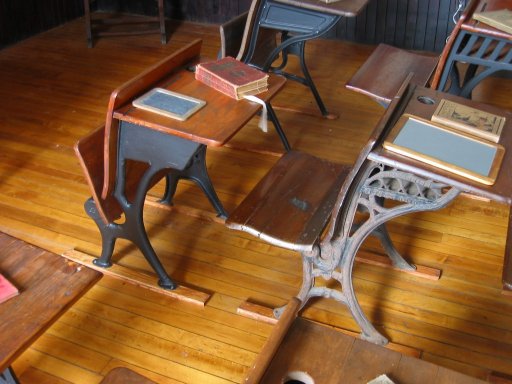
When I was in high school many, nay most, of the classrooms in our 80 year old building still had the original desks. I always found these to be really cool and loved being in rooms with them despite the fact that the desks were made for a smaller generation. Notice the cutout for an inkwell in in upper right corner. Back in my dad's day, some of them still had the glass inkwell in them.
Fast forward many years to the start of my own teaching career. My school still had a few rooms of the original furniture but most rooms had desks that looked like this (the one on the right). The benefit of these desks is that they were separate from the chairs and larger students were more comfortable. They could also be moved around for group work or (cooperative learning as the buzz word was back in my day). The draw back was that the pocket under the table top served as a depository for all sorts of garbage. Literally. My last class of the day quickly got into the habit of "dumping" a third of the desks every Friday and all of them right before a long break. Teachers that did not do this often found themselves faced with a mouse jumping out at a kid during class. Eek!
Then the trend turned toward the tablet type of desk (scroll down) because they did not have the garbage-collecting pockets. We buy the big ones but the smaller ones allow for many more kids in a room or, conversely, more room to move around with the same number of kids. The smaller ones, however are really not practical for spreading out papers and such so we have divested our selves of the few we had. Tablet desks are movable but not great for group work. They all have a slight slant to them and are awkward to put together to make larger surfaces. The final drawback is that, like the original fixed desks, they have limited room for the larger student.
It has been part of my job over the last few years to replace the remaining pocket desks with big tablet desks. Just when I was about to complete the conversion (this is done over many years due to the cost of the desks) the trend changed again. Last spring I was asked to order two types of tables. The first is totally new to our school -- the "kidney bean." I remember sitting at a table like this in my "open classroom" in third grade. They are good for group work but I have my concerns about them for testing. The second is a standard table and is multi-functional. Put two together and you have a square with seating for 8. Line them up and make corners and you have a hollow square or a "U" or an "L." Again, not great for testing but not too bad and they have a lot of possibilities. Personally, I like these better then the tablet desks.
What will the next trend be in seating? Will we start hanging the kids from the ceiling or turning them on their sides? Who knows? Only time will tell.
***
When I was in high school many, nay most, of the classrooms in our 80 year old building still had the original desks. I always found these to be really cool and loved being in rooms with them despite the fact that the desks were made for a smaller generation. Notice the cutout for an inkwell in in upper right corner. Back in my dad's day, some of them still had the glass inkwell in them.
Fast forward many years to the start of my own teaching career. My school still had a few rooms of the original furniture but most rooms had desks that looked like this (the one on the right). The benefit of these desks is that they were separate from the chairs and larger students were more comfortable. They could also be moved around for group work or (cooperative learning as the buzz word was back in my day). The draw back was that the pocket under the table top served as a depository for all sorts of garbage. Literally. My last class of the day quickly got into the habit of "dumping" a third of the desks every Friday and all of them right before a long break. Teachers that did not do this often found themselves faced with a mouse jumping out at a kid during class. Eek!
Then the trend turned toward the tablet type of desk (scroll down) because they did not have the garbage-collecting pockets. We buy the big ones but the smaller ones allow for many more kids in a room or, conversely, more room to move around with the same number of kids. The smaller ones, however are really not practical for spreading out papers and such so we have divested our selves of the few we had. Tablet desks are movable but not great for group work. They all have a slight slant to them and are awkward to put together to make larger surfaces. The final drawback is that, like the original fixed desks, they have limited room for the larger student.
It has been part of my job over the last few years to replace the remaining pocket desks with big tablet desks. Just when I was about to complete the conversion (this is done over many years due to the cost of the desks) the trend changed again. Last spring I was asked to order two types of tables. The first is totally new to our school -- the "kidney bean." I remember sitting at a table like this in my "open classroom" in third grade. They are good for group work but I have my concerns about them for testing. The second is a standard table and is multi-functional. Put two together and you have a square with seating for 8. Line them up and make corners and you have a hollow square or a "U" or an "L." Again, not great for testing but not too bad and they have a lot of possibilities. Personally, I like these better then the tablet desks.
What will the next trend be in seating? Will we start hanging the kids from the ceiling or turning them on their sides? Who knows? Only time will tell.
Thursday, September 06, 2007
On Chalk
Chalk has become the much maligned stepchild of the teaching world. Outshone first by white boards, then overhead projectors and now Smartboards, the use of chalk in schools is decreasing with alarming rapidity.
When I first became an Assistant Principal in 1999, our stockman informed me that we had plenty of chalk and I would not have to order for quite a while. I figured that he meant that my predecessor had spent out a surplus one year and that we had a year or two worth of chalk stashed away. In the Spring, I asked again and was once again assured that we had plenty of chalk.
Fast forward to 2007. I had to know. I asked for the whole, dusty, story. Apparently, when our stockman took his job, 26 years ago, the chalk was already there. Some long ago APO (my position) had likely invested the last of the closing school's budget in chalk. Maybe it was meant as a joke for the incoming school or, maybe it was meant as a present. Whatever the reason, they bought a whole lot of it.
A box of chalk -- 144 pieces are inside in 12 smaller boxes
Yesterday I asked our stockman to count the number of cases remaining in his "chalkroom." There are 12 cases and we go through about 2-3 cases a year. That means, yes, I did the math, that at current usage rates we have 4-6 years worth of chalk. I have not purchased white chalk for the school -- ever (I've purchased plenty of colored chalk). Given the decreasing rate of usage, I may never buy chalk. When I do, apparently I will have to do some chalk previews first, because I am told that modern chalk is inferior to our 26 year old chalk. On the rare occasions that some new chalk has come into the building (occasionally another AP does not believe that we have plenty of chalk) the newer stuff is found to be a poor cousin to the old "dustless" chalk.
Chalk, and chalkboards -- be the black, green or brown -- are a wonderful way to communicate ideas. You can scrawl a diagram on a board, add to it, subtract from it (with the assistance of an eraser) and bring to life an abstract idea. For notes that are going up on the board, period after period, I admit that an overhead or computer is the way to go but for diagrams, chalk can't be beat. Add the colored stuff and I'm in heaven! Yes, I taught biology and loved my diagrams. I had overheads with layers that worked wonders but nothing beats seeing the strokes a teacher is using in order for a student to reliably recreate the diagram in their own note book. Why not use a hand out? Because the physical action of drawing the diagram helps the student retain it in their memory. Yes, I really believe this. It is how I learn so there are others out there who learn the same way. A static drawing is just not the same. Yes, some kids are not artists -- hey, neither am I. I was always happy to furnish a copy for them but no one ever took me up on the offer.
I understand the demise of chalk and I will miss it when it is gone. Like rexographs, mimeographs and thermofaxes, chalk in a classroom will eventually be obsolete, replaced by all sorts of technological doodads. And when they break ... how will we cope?
Chalk, and chalkboards -- be the black, green or brown -- are a wonderful way to communicate ideas. You can scrawl a diagram on a board, add to it, subtract from it (with the assistance of an eraser) and bring to life an abstract idea. For notes that are going up on the board, period after period, I admit that an overhead or computer is the way to go but for diagrams, chalk can't be beat. Add the colored stuff and I'm in heaven! Yes, I taught biology and loved my diagrams. I had overheads with layers that worked wonders but nothing beats seeing the strokes a teacher is using in order for a student to reliably recreate the diagram in their own note book. Why not use a hand out? Because the physical action of drawing the diagram helps the student retain it in their memory. Yes, I really believe this. It is how I learn so there are others out there who learn the same way. A static drawing is just not the same. Yes, some kids are not artists -- hey, neither am I. I was always happy to furnish a copy for them but no one ever took me up on the offer.
I understand the demise of chalk and I will miss it when it is gone. Like rexographs, mimeographs and thermofaxes, chalk in a classroom will eventually be obsolete, replaced by all sorts of technological doodads. And when they break ... how will we cope?
Wednesday, September 05, 2007
The Delaney Card
This evening's conversation turned to the subject of middle school contact cards, with Squidette whining about having to fill out one for every class. At some point in her diatribe I interrupted and asked if any of her teachers used Delaney Cards. "What is a Delaney Card," she queried. At this point I waxed poetic about the magnificence of the Delaney Card.
Delaney Cards are the wonderful invention of Edward C. Delaney. They are beloved by teachers and hated by students who seem to think they can lead to impersonality on behalf of their instructors. When I called three of my siblings, one commented that "only the loser teachers who couldn't bother to learn our names used Delaney Cards." Another felt much the same way but backed off a bit when I expressed my view on learning student names. The third mentioned that he had just been thinking about them, nostalgically, as he took his son on a tour of his new middle school.
Delaney Cards can be used for a whole variety of tasks. The first and foremost role of the Delaney Card (click on the first link for a picture of said card) is for seating and attendance. The cards fit neatly into slots on pages that fit easily into either a standard Delaney Book or a plain old looseleaf binder. Personally I preferred a binder since the Delaney books tend to lose their covers after only a year or so and the binder had more room for other stuff. T
he kids fill out the cards, following either the designations on the cards or the teacher's altered instructions and the teacher places the cards in the slots according to where the kids are sitting in the room. Now I admit, this works best if the room is arranged in old fashioned rows -- something that is currently frowned upon.
For attendance purposes, the teacher glances at the room and, if a student is missing from their seat, flips the card from black side to red side and makes a notation on the date in question. Different marks mean different things. a "/" means absent. When the kid brings in a note you then cross the mark and make it an "x" for excused. No note, no "X." A circle indicates a lateness and a "C" indicates a cut -- thats for the kid you saw in the hallway later in the day. At the end of the day you glance at all the red cards and bubble in the absences on the machine scanable attendance forms. No calling of student names unless you want to (a good back up for the first few days when you really don't know the names) and attendance is quick and painless.
The front of the card can be used to note grades or participation marks or discipline marks or anything you want. A former colleague used to keep all of his grades on the Delaney Card. No messing with a grade book for him. Everything was there in tiny, very legible handwriting.
In my own case, I used them for attendance and for participation grades. After a week or two, when I had finally memorized the names of the kids -- made easier by constantly referring to the Delaney book instead of having to keep asking the kids for their names -- I would take the cards out of the book and shuffle them around for use in organizing groups or randomly calling kids for questions. It was always a test of my memory to see if I could then put them back in the book correctly.
I love Delaney Cards and always make sure that our school is well stocked with them. In my humble opinion, Delaney Cards are the glue that keeps New York City schools together. If I ever get back into the class room, the first thing I will do is grab a big ol' stack of Delaney Cards.
Delaney Cards are the wonderful invention of Edward C. Delaney. They are beloved by teachers and hated by students who seem to think they can lead to impersonality on behalf of their instructors. When I called three of my siblings, one commented that "only the loser teachers who couldn't bother to learn our names used Delaney Cards." Another felt much the same way but backed off a bit when I expressed my view on learning student names. The third mentioned that he had just been thinking about them, nostalgically, as he took his son on a tour of his new middle school.
Delaney Cards can be used for a whole variety of tasks. The first and foremost role of the Delaney Card (click on the first link for a picture of said card) is for seating and attendance. The cards fit neatly into slots on pages that fit easily into either a standard Delaney Book or a plain old looseleaf binder. Personally I preferred a binder since the Delaney books tend to lose their covers after only a year or so and the binder had more room for other stuff. T
he kids fill out the cards, following either the designations on the cards or the teacher's altered instructions and the teacher places the cards in the slots according to where the kids are sitting in the room. Now I admit, this works best if the room is arranged in old fashioned rows -- something that is currently frowned upon.
For attendance purposes, the teacher glances at the room and, if a student is missing from their seat, flips the card from black side to red side and makes a notation on the date in question. Different marks mean different things. a "/" means absent. When the kid brings in a note you then cross the mark and make it an "x" for excused. No note, no "X." A circle indicates a lateness and a "C" indicates a cut -- thats for the kid you saw in the hallway later in the day. At the end of the day you glance at all the red cards and bubble in the absences on the machine scanable attendance forms. No calling of student names unless you want to (a good back up for the first few days when you really don't know the names) and attendance is quick and painless.
The front of the card can be used to note grades or participation marks or discipline marks or anything you want. A former colleague used to keep all of his grades on the Delaney Card. No messing with a grade book for him. Everything was there in tiny, very legible handwriting.
In my own case, I used them for attendance and for participation grades. After a week or two, when I had finally memorized the names of the kids -- made easier by constantly referring to the Delaney book instead of having to keep asking the kids for their names -- I would take the cards out of the book and shuffle them around for use in organizing groups or randomly calling kids for questions. It was always a test of my memory to see if I could then put them back in the book correctly.
I love Delaney Cards and always make sure that our school is well stocked with them. In my humble opinion, Delaney Cards are the glue that keeps New York City schools together. If I ever get back into the class room, the first thing I will do is grab a big ol' stack of Delaney Cards.
Tuesday, September 04, 2007
Stash Smackdown
Or maybe use down? In January I started keeping track of all of the yarn that came in to and left my apartment. The goal was to achieve at least a steady state in regards to numbers of yarn "units" (balls, skeins, hanks etc.) in the apartment. Unspun fiber does not count until it is spun, plied, skeined, washed and dried -- then it counts as "fiber in."
On the way home from Indiana I hit a steady state after months of the "ins" outnumbering the "outs." Then my friend came back from China and gave me three skeins of silk. Then I finished plying some yarn that had been sitting on a bobbin for far too long. All of a sudden I had a positive balance again and all I was knitting was cobweb lace. Not a huge yarn user.
Thinking fast, I grabbed needles, worsted weight yarn and cast on for another baby surprise. One ball down and I am back at steady state and approaching negative balance. I even went into Knitty City, bought 3 balls of yarn and promptly mailed them off to my sister-in-law. That's right, nothing for me!
My plan now is to finish the baby surprise and then return to the lace shawl until I finish plying up the lace weight alpaca and wind up in a positive balance again. Then I will cast on another worsted weight project ... and you get the idea.
What do you think? Can I end the year with a negative balance? Even with Rhinebeck looming?
On the way home from Indiana I hit a steady state after months of the "ins" outnumbering the "outs." Then my friend came back from China and gave me three skeins of silk. Then I finished plying some yarn that had been sitting on a bobbin for far too long. All of a sudden I had a positive balance again and all I was knitting was cobweb lace. Not a huge yarn user.
Thinking fast, I grabbed needles, worsted weight yarn and cast on for another baby surprise. One ball down and I am back at steady state and approaching negative balance. I even went into Knitty City, bought 3 balls of yarn and promptly mailed them off to my sister-in-law. That's right, nothing for me!
My plan now is to finish the baby surprise and then return to the lace shawl until I finish plying up the lace weight alpaca and wind up in a positive balance again. Then I will cast on another worsted weight project ... and you get the idea.
What do you think? Can I end the year with a negative balance? Even with Rhinebeck looming?
Monday, September 03, 2007
600 Miles!
Yes, we did it. The kids bought the need to get to 600 and Squidette mapped out an interesting route. She was promptly vetoed by the males who felt no need to explore today in favor of a "same old" ride.
So, up to Little Red it was and back down, stopping at Fairway to pick up some provisions.
Then, a small blip in the "same old" as we rode east to a street fair on Lexington Avenue in search of a birthday present for Little Squid.
Deserted 46th Street
Empty Lexington Avenue
Tomorrow, back to school.
So, up to Little Red it was and back down, stopping at Fairway to pick up some provisions.
Little Red Lighthouse
A street fair lunch for the kids, success in the shopping and then downtown on a practically deserted Lexington Avenue. Kind of spooky, actually. Lex is usually "wall to wall" cars. Personally, I hate it. I hate to drive it. I hate to ride a bus on it. I hate to walk on it. I find it to be one of the narrowest avenues and it makes me somewhat claustrophobic.
Total ride: 19.5 miles. See the route here.
Frankly, I have to admit that much of Manhattan makes me claustrophobic these days. Yesterday, the kids and I walked up to Times Square, stopping in B & H along the way. B & H was wall to wall people. We got out of there as quickly as we could. Then we went to Toy's R Us and found a similar situation. The Swatch store was mostly empty but everything else ... phew! After Swatch I remembered about the Little Brazil street fair and, in search of Little Squid's birthday present, proposed we walk another block to get to it. Bad idea. It was so tightly packed at the intersection we came in on that we turned around and went home. Eek! Too many people! And too many drunk people!
Tomorrow, back to school.
Sorry All
I know I've been quiet this week. Readjusting to a work schedule is never easy and I come home, vent to Mike and pretty much call it a day. This week included some additional child movements in order to deal with the two days that both Mike and I were at work but where the kids were not yet in school.
Kristen asked if we have time to ride in the evenings and sadly the answer is no. Early in the school year I tend to come home on the later side as my list of tasks is longer then the school day is. By the time I can start working a "contractual day" it is already starting to get dark by the time I get home. We make up for it with longer rides on the weekends when possible.
I have to admit that Mike and I are a bit driven about numbers right now. Last weekend we did that 38 mile ride and then looked at each other and the kids and said "only a few more miles to 55o, come on" and persuded them to ride again. Last night we did the same thing "hey, only 18 more miles for 600. We can do it with a ride to Little Red and then back to chocolate ..." We'll see if they go for it. I'm hoping so since we are out of chocolate and I have packages to get in the mail.
Meanwhile, some images from Saturday.
Back to school shopping for Mama (the blazers are red linen, navy wool and a shiny bright olive silk.)
The "Fashion Avenue" information kiosk.
My favorite "billboard." Notice the scaffolding just below her nose.
And some happy mailboxes we found on 5th Avenue.
Kristen asked if we have time to ride in the evenings and sadly the answer is no. Early in the school year I tend to come home on the later side as my list of tasks is longer then the school day is. By the time I can start working a "contractual day" it is already starting to get dark by the time I get home. We make up for it with longer rides on the weekends when possible.
I have to admit that Mike and I are a bit driven about numbers right now. Last weekend we did that 38 mile ride and then looked at each other and the kids and said "only a few more miles to 55o, come on" and persuded them to ride again. Last night we did the same thing "hey, only 18 more miles for 600. We can do it with a ride to Little Red and then back to chocolate ..." We'll see if they go for it. I'm hoping so since we are out of chocolate and I have packages to get in the mail.
Meanwhile, some images from Saturday.
Back to school shopping for Mama (the blazers are red linen, navy wool and a shiny bright olive silk.)
My favorite "billboard." Notice the scaffolding just below her nose.
And some happy mailboxes we found on 5th Avenue.
Sunday, September 02, 2007
Squid on Wheels -- Jamaica Bay
This morning we took off to explore the Jamaica Bay Wildlife Preserve, part of the Gateway National Recreation Area.
Not being totally sadistic parents, we drove first to Floyd Bennett Field where we parked the car and unfolded the bikes. Then, we circumnavigated Jamaica Bay and, having cycled only 22 miles, explored Floyd Bennett Field where we saw some radio-controlled airplanes and cars being guided around the wide open spaces. Floyd Bennett field was the first municipal airport in New York City and was, in its time, a very modern field.
Had a whale of a good time on Rockaway Beach!
Yes, we surf in NYC!
Reentering Brooklyn. Anyone not get the reference?
Leaving Brooklyn. Had to explain this one to both kids.
A training tower?

The Concorde at Floyd Bennett Field -- on loan from the Intrepid Air, Sea and Space Museum
Jamaica Bay from Floyd Bennett Field
If you wish to see our route (approximately) go here. You will notice that part of our ride was not on road per se. It was actually on the old landing strips of the air field. Yes, it was rather cool to ride on an airstrip. Google pedometer is measuring it at 26.4 miles. Our GPS's and bike computers measured it at an even 28 miles. I probably left out some of our meanderings as I translated it into the pedometer. For more photos go here and here.
Not being totally sadistic parents, we drove first to Floyd Bennett Field where we parked the car and unfolded the bikes. Then, we circumnavigated Jamaica Bay and, having cycled only 22 miles, explored Floyd Bennett Field where we saw some radio-controlled airplanes and cars being guided around the wide open spaces. Floyd Bennett field was the first municipal airport in New York City and was, in its time, a very modern field.
Over the 28 miles, we crossed 8 bridges and rode in two boroughs. We rode along the waters of Jamaica Bay and the Atlantic Ocean and across old airplane landing strips and helicopter landing pads. Our tires crossed paths strewn with crushed sea shells (perhaps dropped there by seagulls trying to get the meat out?) and miles and miles of asphalt. We saw the spic and span houses of Howard Beach and the more rundown ones of Rockaway Beach. All in all, a very nice ride.
Leaving Brooklyn. Had to explain this one to both kids.
The Concorde at Floyd Bennett Field -- on loan from the Intrepid Air, Sea and Space Museum
If you wish to see our route (approximately) go here. You will notice that part of our ride was not on road per se. It was actually on the old landing strips of the air field. Yes, it was rather cool to ride on an airstrip. Google pedometer is measuring it at 26.4 miles. Our GPS's and bike computers measured it at an even 28 miles. I probably left out some of our meanderings as I translated it into the pedometer. For more photos go here and here.
Wednesday, August 29, 2007
Squid Awake
I've got back to school jitters tonight. Interesting since I returned to work on Monday but the teachers come back tomorrow so that is probably the source of my insomnia.
There is an addendum to yesterday's post -- the 2:30 a.m. mass at St. Andrew's Church (RC) was called the Printer's Mass because it was held after the newspapers finished printing for the night. The printers were then able to attend mass before heading home from work. St. Andrew's also held a noon mass (I do not know if this is common now but apparently it wasn't back then). The noon mass was to accommodate the working people on their lunch break and was apparently very popular.
One last note before I try to knit myself into a state where I can sleep -- the contest closes at the end of the day on Friday, August 31. Get your entries in while you can! Yes, this does leave you guessing as to what we will do on the upcoming long weekend. Deal with it.

There is an addendum to yesterday's post -- the 2:30 a.m. mass at St. Andrew's Church (RC) was called the Printer's Mass because it was held after the newspapers finished printing for the night. The printers were then able to attend mass before heading home from work. St. Andrew's also held a noon mass (I do not know if this is common now but apparently it wasn't back then). The noon mass was to accommodate the working people on their lunch break and was apparently very popular.
One last note before I try to knit myself into a state where I can sleep -- the contest closes at the end of the day on Friday, August 31. Get your entries in while you can! Yes, this does leave you guessing as to what we will do on the upcoming long weekend. Deal with it.
Papa Squid, Squidette and one of the many Uncle Squid. Notice how grown up Squidette has become. Sniff.
Monday, August 27, 2007
Squid on Feet -- Part 2
Nothing interesting to report today except that Papa and the Squidlings enjoyed their trip to the newly renovated Liberty Science Center. Instead you get a tour of Lower Manhattan that we took last week when we had a sudden craving for dim sum for lunch.
Our tour starts as we exit the subway at City Hall and wind our way to the surface via the Municipal Building.
Many of our city's government agencies are located here, including the marriage bureau for those quick "city hall" weddings.
(the ceiling tiles in the arch pictured above)
It was impossible for me to get far enough back to get all of this magnificent building into a photo so be sure to click on the link above for more detailed pictures.
The sign in the foreground is for Reade Street, the one further back is for Duane Street. Yes New Yorkers, these are the Duane and Reade of the ubiquitous pharmacy. Did you know that on 57th Street and Broadway you get a Duane Reade on both the South East and South West corners? And they do not have the same stock.
Shortly before the civil war, St. Andrew's Church, suffering a downturn in participation, received permission from Rome to hold a 2:30 a.m mass. This was known as the Printer's Mass and served as the catalyst for a renewal of the congregation. Later, St. Andrew's instituted a noon time mass to serve the growing numbers of municipal workers. The building shown above is not the original St. Andrews, that one was torn down to make way for the adjacent Federal Court House. The current structure was erected in 1939.*
The Sugar House was used to hold prisoners during the Revolutionary War. All that is left is some bricks and the barred window.
The Supreme Court of New York.
The Five Points -- one of the most infamous sections of early New York gang activity. Now a public park.
The site of the Collect Pond, originally a font of fresh water, later a contaminated cesspool drained via a canal which was later filled in to become ... you guessed it, Canal Street.
Our favorite billboard. Proof that Dumbo is not on the radar of a certain Mouse.
My only picture from Chinatown. For some reason I decided to turn New Yorker and put away the camera. Lunch was an assortment of dim sum from our favorite dim sum house. Yummy!
The building shown both above and below is a former police station, renovated and now an apartment building.


The original Grace Church across from the NYU dormitory where Mike once lived.

A bank building that is now used for a variety of itinerant commercial purposes. One day last summer it showcased the Ben and Jerry's milkshake in a bottle, this week, Meow Mix cat food.

* Wolfe, Gerard, New York A guide to the Metropolis Walking Tours of Architecture and History, Second Edition, McGraw Hill 1988
Our tour starts as we exit the subway at City Hall and wind our way to the surface via the Municipal Building.
(the ceiling tiles in the arch pictured above)
* Wolfe, Gerard, New York A guide to the Metropolis Walking Tours of Architecture and History, Second Edition, McGraw Hill 1988
Sunday, August 26, 2007
Squid On Wheels Contest Reminder
For those of you holding out until the end of the month to enter your guess I give you this: the total will most likely hold steady until after the contest deadline. I go back to work tomorrow and the likelyhood of Papa and the Squidlings riding without me is slim.
Go to this post to lodge your guesses.
Subscribe to:
Comments (Atom)